Brass Cufflinks
This post was written after the fact in August 2026.
In mid-2024 I purchased a Proxxon IBS/E rotary tool (much like the better-known Dremel) with the intent of using it for small sanding, polishing, engraving and grinding/cutting jobs. I also bought a few accessories with the hope of using it as a micro milling machine: the MB 200 drill stand, KT 70 compound table, MS 4 vice and an assortment of cheap 1/8” shank endmills.
This micro-mill setup is far from optimal: the “spindle” has very little torque and a very high minimum speed (~5,000 RPM); the collet chuck is a non-standard system with a maximum size of 1/8”; the vice doesn’t come with a single machined reference surface; and nothing about the system is rigid enough for real precision work. All that said, it is well made, extremely compact, quite affordable and able to make decent cuts in plastic, aluminium and brass if you work within its limitations.
One trick that expanded the system’s capabilities was realising that an endmill could be held in the vice and used to cut a suitably-sized workpiece held in the collet chuck, functioning as a simple lathe - pictured here after a test cut.
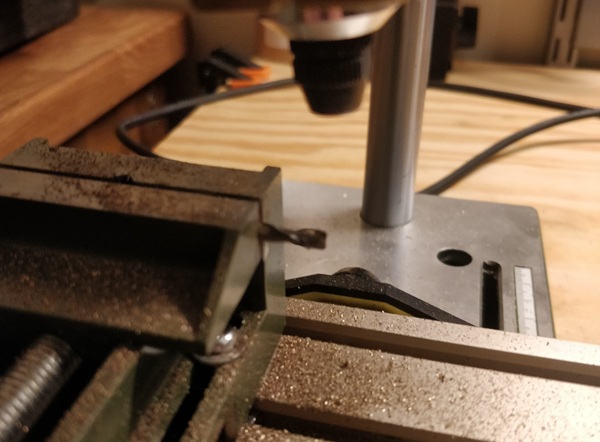
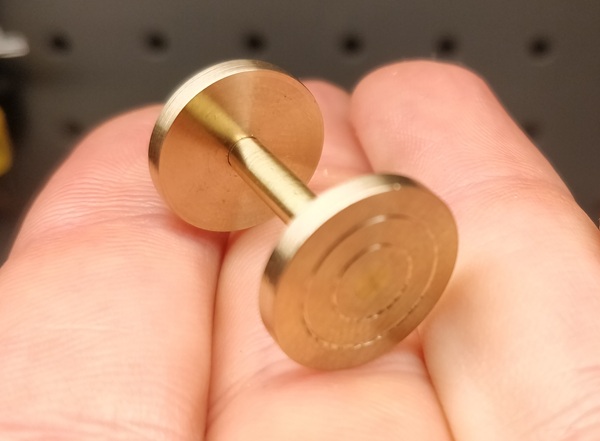
To get around the collet size limitation, a slightly larger workpiece can be attached to a mandrel which fits in the collet. This gave me the idea of making cufflinks: a 3mm brass shank, with a disk soldered to one end and another tapped and threaded onto the other end. Both disks were cut from 16x2mm bar stock and machined using the final shank of the cufflink as the workholding mandrel.
The front/outwards-facing disk was faced after soldering to the shank to somewhat hide the joint and has a simple decorative pattern of circular grooves:
The rear end of the shank is tapered to help start the thread when putting on the cufflinks:
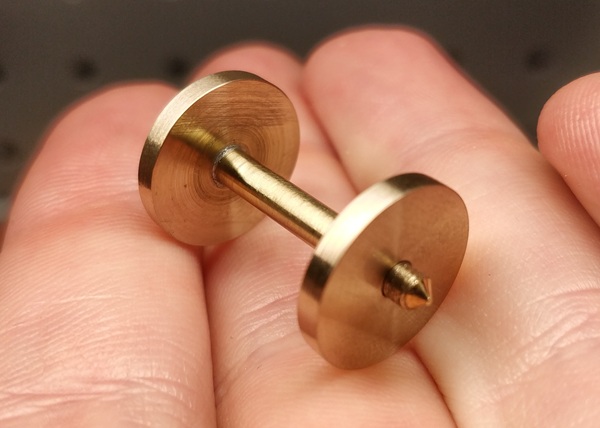
In retrospect, the thread on the shank should have been shorter so that only the tapered end of the shank pokes out from the rear disk.
The idea could be taken further with more detailed decoration and a more refined surface finish - possibly a well-defined grain rather than a mirror finish, and protected with a clear coat of lacquer.